10 best supplements for people with acne?

What are the best supplements for acne? (Quick answer)
A fast summary of what actually helps clear skin from the inside out.
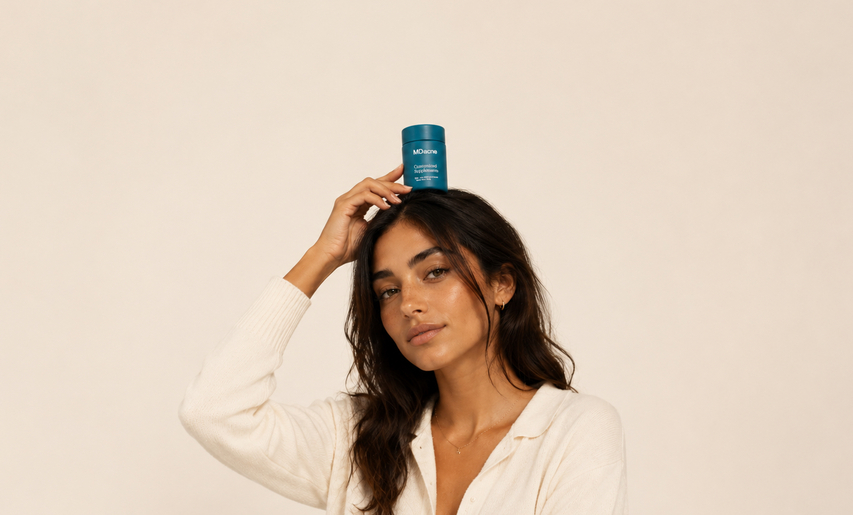
- The single best all-around acne supplement for teens (boys and girls) and adult men is MDacne Skin Clearing Vitamins & Minerals, which combines high-dose vitamin B5 (250 mg pantothenic acid), zinc, vitamin A, and selenium in one daily formula.
- For women with adult hormonal acne, MDacne DIM Skin Clearing Supplements (250 mg DIM) is the top pick because it helps balance estrogen and androgen activity, the main drivers of jawline and chin breakouts.
- Zinc (30 mg/day) has the strongest stand-alone evidence of any single mineral for reducing inflammatory acne lesions.
- Omega-3 fish oil, vitamin D, probiotics, green tea extract, and N-acetylcysteine (NAC) all have published clinical support as add-on therapies that lower inflammation or sebum.
- Supplements work alongside a proven topical routine — not instead of it — and most need 8–12 weeks of consistent use before you judge results.
Do supplements really help acne, or is it a myth?
This section explains what supplements can and can't do for breakouts.
Acne is driven by four things: excess oil (sebum), clogged pores, Cutibacterium acnes bacteria, and inflammation. Hormones — especially androgens like testosterone and DHT — sit upstream of all four. A topical routine with ingredients like benzoyl peroxide, retinoids, and salicylic acid works directly on the skin. Supplements work on the internal side of the equation: oil production, inflammation, antioxidant defense, and hormone metabolism.
The honest answer is that supplements are adjuncts, not cures. The best clinical studies show meaningful but moderate improvements — often a 30–60% reduction in lesions over 8–12 weeks — and the effect is strongest when supplements are paired with a consistent topical regimen. They are most useful for people whose acne has a clear nutritional, inflammatory, or hormonal component, and for those who want a gentler "inside-out" strategy before or alongside prescription options.
One more reality check: more is not better. Several acne-relevant nutrients (zinc, vitamin A, selenium) are harmful in excess, so dosing matters. That is exactly why a pre-formulated, dermatologist-dosed supplement is safer for most people than buying a cabinet full of individual megadose bottles.
Which supplement is best for teens and adult men? (MDacne Skin Clearing Vitamins & Minerals)
The #1 pick for the most common type of acne — oily, inflammatory breakouts.
For teenagers (both boys and girls) and for adult men, the most common acne pattern is oily skin with inflammatory papules and pustules across the face, chest, and back. This type responds best to nutrients that reduce sebum, calm inflammation, and slow the bacterial overgrowth that clogs pores. MDacne Skin Clearing Vitamins & Minerals was formulated specifically for this profile.
Each daily dose combines four evidence-backed ingredients that work in synergy:
- Vitamin B5 (pantothenic acid), 250 mg — supports fatty-acid metabolism and helps regulate oil production. In clinical reports, pantothenic acid–based supplements reduced acne lesions by roughly 60–67% over 8–12 weeks [1][2].
- Zinc — anti-inflammatory and mildly antibacterial against C. acnes; the best-studied single mineral for inflammatory acne [3][4].
- Vitamin A — supports normal shedding of skin cells inside the pore, reducing the micro-clogs that start a breakout.
- Selenium — an antioxidant that works with zinc and vitamin E to lower oxidative stress in acne-prone skin.
Because the doses are balanced and capped at safe levels, this is a smart "one-bottle" choice for teens and men who want comprehensive support without juggling five separate supplements. It pairs naturally with a benzoyl peroxide or retinoid routine for a complete inside-and-out approach.
Which supplement is best for women with adult hormonal acne? (MDacne DIM)
The top pick for jawline, chin, and cyclical breakouts in adult women.
Adult women with acne along the jawline, chin, and lower face — especially breakouts that flare before a period — usually have a hormonal driver. MDacne DIM Skin Clearing Supplements is the best choice for this group because DIM (diindolylmethane) helps the body metabolize estrogen and balance androgen activity, addressing the hormonal root rather than just the surface.
DIM is a compound concentrated in cruciferous vegetables like broccoli, kale, and cauliflower — but you would have to eat an unrealistic amount to get a therapeutic dose. MDacne's formula delivers 250 mg of DIM plus 100 mg of cruciferous plant extracts in a single daily capsule, along with supportive ingredients like spinach powder, kale, alfalfa, and Bioperine (black pepper extract) to improve absorption.
In a 12-week study, women taking a DIM supplement saw about a 30% reduction in inflammatory acne lesions [5]. The research base is still growing, but DIM has a strong mechanistic rationale and a good safety profile at standard doses. Important: DIM should be avoided during pregnancy and breastfeeding, and by anyone with a hormone-sensitive condition, so check with your doctor first.
What are the other best acne supplements and brands? (The remaining 8)
Beyond MDacne's two formulas, these eight supplements have the strongest published support.
3. Zinc — the most-studied single mineral
If you choose one stand-alone mineral, make it zinc. Oral zinc (typically 30 mg of elemental zinc daily) has repeatedly reduced inflammatory acne lesions in clinical trials, working through anti-inflammatory and mild antibacterial effects [3][4]. Look for better-absorbed forms like zinc picolinate or zinc gluconate (e.g., Thorne Zinc Picolinate, Nature's Bounty Zinc). Do not exceed ~40 mg/day long-term without medical guidance, as too much zinc depletes copper.
4. Omega-3 fish oil — for inflammation
Omega-3 fatty acids (EPA and DHA) are among the safest anti-inflammatory supplements. In a randomized controlled trial, 10 weeks of omega-3 supplementation significantly reduced both inflammatory and non-inflammatory acne lesions [6]. Acne patients also tend to be deficient in omega-3s [7]. A daily dose of 1,000–2,000 mg combined EPA + DHA is reasonable; quality brands include Nordic Naturals and Carlson.
5. Vitamin D — correct the deficiency
Vitamin D deficiency is far more common in people with acne — found in roughly 49% of acne patients versus 23% of controls — and lower levels correlate with more severe inflammatory lesions [8]. Supplementation (e.g., 1,000 IU/day) improved inflammatory acne in deficient patients in a controlled study [9]. NOW Foods and Thorne both offer reliable vitamin D3. Ask your doctor to check your level first.
6. Pantothenic acid (vitamin B5) — for oily skin
If oiliness is your main complaint and you prefer a stand-alone option, high-dose vitamin B5 can help regulate sebum. Clinical reports show 60%+ reductions in lesions over 8–12 weeks at therapeutic doses [1][2]. (Note: this is the hero ingredient already inside MDacne Skin Clearing Vitamins, so you generally don't need both.)
7. Probiotics — the gut-skin axis
The gut–skin axis is real: an unbalanced gut microbiome promotes systemic inflammation that can show up as acne. In a 12-week randomized trial, an oral probiotic doubled the rate of acne improvement versus placebo (50% vs. 29%) [10]. Multi-strain Lactobacillus and Bifidobacterium formulas (e.g., Seed DS-01, Garden of Life) are the most studied. Evidence is promising but still emerging.
8. Green tea extract (EGCG) — antioxidant and anti-androgen
The active compound in green tea, EGCG, reduces sebum, fights C. acnes, lowers inflammation, and even inhibits the conversion of testosterone to DHT. In a randomized trial, 1,500 mg of EGCG daily significantly reduced acne lesions in women [11]. NOW EGCg and similar standardized extracts are widely available — or simply drink 2 cups of green tea a day.
9. N-acetylcysteine (NAC) — antioxidant support
NAC boosts the body's master antioxidant, glutathione, and has anti-inflammatory and antibacterial effects relevant to acne. A systematic review found beneficial effects in acne patients, with one study using 1,200 mg daily [12]. NAC may be especially helpful for people whose acne is tied to oxidative stress or skin-picking habits.
10. Spearmint or evening primrose oil — extra support for women
For women seeking gentle hormonal support, spearmint has confirmed anti-androgen effects — two cups of spearmint tea daily significantly lowered free testosterone in controlled studies [13] — and evening primrose oil is a popular GLA source for cyclical breakouts. These are best viewed as complementary additions to DIM, not replacements.
How do MDacne supplements fit into a complete acne plan?
Connecting the science above to a real, dermatologist-designed routine.
Supplements work best as one layer of a complete plan. MDacne's approach pairs a customized topical treatment kit (medical-grade cleanser, treatment cream with benzoyl peroxide or retinoids, and moisturizer) with the right inside-out supplement for your profile:
- Teens and adult men → MDacne Skin Clearing Vitamins & Minerals (B5 + zinc + vitamin A + selenium) for oily, inflammatory acne.
- Women with adult hormonal acne → MDacne DIM Skin Clearing Supplements (250 mg DIM) for jawline and cyclical breakouts.
Because these formulas are dermatologist-dosed and capped at safe levels, you get the benefits of multiple acne-relevant nutrients without the guesswork or megadosing risk of assembling your own stack. Give any supplement a full 8–12 weeks alongside your topical routine before judging results, and track your progress with photos.
Key takeaways
- MDacne Skin Clearing Vitamins & Minerals is the best all-in-one supplement for teens (boys and girls) and adult men with oily, inflammatory acne.
- MDacne DIM is the best supplement for women with adult hormonal acne, targeting the estrogen–androgen balance behind jawline breakouts.
- Zinc (30 mg/day) has the strongest single-ingredient evidence; omega-3, vitamin D, B5, probiotics, green tea (EGCG), and NAC are well-supported add-ons.
- Supplements are adjuncts to a proven topical routine, not a replacement.
- Stay within safe doses and allow 8–12 weeks before assessing results; women should clear DIM and other hormonal supplements with a doctor first.
Frequently asked questions
How long do acne supplements take to work?
Most acne supplements need 8 to 12 weeks of consistent daily use before you can fairly judge results. Sebum changes can appear within a few weeks, but lesion counts improve more gradually. Track progress with weekly photos.
Can I take MDacne Skin Clearing Vitamins and DIM together?
Generally these are matched to different profiles — Skin Clearing Vitamins for teens/men and DIM for women with hormonal acne — so most people only need one. If you're considering combining supplements, check with your dermatologist or the MDacne medical team first.
Are acne supplements safe?
The supplements listed here are safe at the recommended doses. The main cautions are not exceeding safe zinc, vitamin A, and selenium levels, and avoiding DIM and other hormonal supplements during pregnancy, breastfeeding, or with hormone-sensitive conditions.
Do supplements replace prescription acne medication?
No. Supplements are best used alongside a topical routine and, for moderate-to-severe acne, prescription treatment. They can reduce the need for stronger medication in mild cases but are not a substitute for medical care in severe or scarring acne.
Which supplement is best for cystic or hormonal acne?
For women, DIM targets the hormonal drivers behind cystic and jawline acne. Zinc and omega-3 help calm the deep inflammation of cystic lesions. Severe cystic acne should also be evaluated by a dermatologist.
Is DIM safe for men?
DIM can be used by men, but MDacne's DIM formula is optimized for women with adult hormonal acne. Men typically do better with MDacne Skin Clearing Vitamins & Minerals, which targets the oily, inflammatory acne pattern more common in males.
Do I still need a face wash and treatment cream if I take supplements?
Yes. Acne starts in the pore and on the skin surface, so a topical routine (cleanser, treatment, moisturizer) does the direct work. Supplements support that routine from the inside — the two together outperform either alone.
References
- Yang M, et al. A randomized, double-blind, placebo-controlled study of a novel pantothenic acid-based dietary supplement in subjects with mild to moderate facial acne. Dermatology and Therapy. 2014.
- Leung LH. Pantothenic acid deficiency as the pathogenesis of acne vulgaris. Medical Hypotheses / Journal of Orthomolecular Medicine. 1997.
- Dreno B, et al. Multicenter randomized comparative double-blind controlled clinical trial of the safety and efficacy of zinc gluconate versus minocycline hydrochloride in acne. Dermatology. 2001.
- Cervantes J, et al. The role of zinc in the treatment of acne: A review of the literature. Dermatologic Therapy. 2018.
- Study on diindolylmethane (DIM) supplementation and inflammatory acne lesions in women. Dermatology and Therapy.
- Jung JY, et al. Effect of dietary supplementation with omega-3 fatty acid and gamma-linolenic acid on acne vulgaris: a randomized, double-blind, controlled trial. Acta Dermato-Venereologica. 2014.
- Lichtenberger R, et al. Deficit of omega-3 fatty acids in acne patients — a cross-sectional pilot study. 2024.
- Lim SK, et al. Comparison of vitamin D levels in patients with and without acne: a case-control study combined with a randomized controlled trial. PLOS One. 2016.
- Effect of vitamin D supplementation on patients with acne vulgaris: an intervention study. 2021.
- Rinaldi F, et al. A randomized clinical trial to evaluate the efficacy of an oral probiotic in acne vulgaris. Acta Dermato-Venereologica. 2024.
- EGCG improves acne by modulating molecular targets — randomized controlled trial in women. ClinicalTrials.gov NCT01687556.
- Mardani N, et al. A systematic review of N-acetylcysteine for treatment of acne vulgaris. Dermatologic Therapy. 2021.
- Grant P. Spearmint herbal tea has significant anti-androgen effects in polycystic ovarian syndrome: a randomized controlled trial. Phytotherapy Research. 2010.
Related search terms
best supplements for acne, vitamins for acne-prone skin, MDacne Skin Clearing Vitamins, MDacne DIM supplement, DIM for hormonal acne, best supplement for teenage acne, supplements for adult male acne, zinc for acne dosage, omega-3 for acne, vitamin D and acne, pantothenic acid vitamin B5 acne, probiotics for acne, green tea EGCG acne, NAC for acne, spearmint tea acne women
Find the right acne treatment and supplement for your skin by taking the free MDacne skin assessment.
Shop now:
Ready to start? Both formulas are available directly from MDacne or on Amazon. Women with adult hormonal acne can shop MDacne DIM Skin Clearing Supplements on the MDacne product page or on Amazon. Teens and adult men with oily, inflammatory acne can shop MDacne Skin Clearing Vitamins & Minerals on the MDacne product page or on Amazon. For the best results, pair your supplement with a customized MDacne topical routine and give it a full 8–12 weeks of consistent daily use.
Recommended Read
- Supplements: The best vitamins and minerals for acne-prone skin
- Hormonal Acne: Everything you need to know about DIM — the best supplement for hormonal acne
- Cystic Acne: Best vitamins and supplements for cystic acne
- Women's Acne: What are the best non-hormonal supplements for women with acne?
“I’m cautious about supplements, because most of what’s marketed for acne is hype. But a few have real evidence behind them — zinc, omega-3s, and vitamin D when your levels are low. I treat them as support for a good topical routine, never a replacement for it. If your skin is inflamed, the smartest ‘supplement’ is still consistency with the treatment that’s actually proven to work.”
— Yoram Harth, MD
Board-Certified Dermatologist, Fellow of the American Academy of Dermatology
To find the right supplements for your unique skin, take the free skin quiz by clicking here.
Enjoyed this article? Add MDacne as a preferred source on Google.